Biomolecular Engineering Lab

Pádua, AC, Osório D, Rodrigues J, Santos G, Porteira A, Palma S, Roque A, Gamboa H.  2018.  Scalable and Easy-to-use System Architecture for Electronic Noses. In Proceedings of the 11th International Joint Conference on Biomedical Engineering Systems and Technologies . :179-186., Madeira: BIODEVICES AbstractPDF

The purpose of this work was the development of a scalable and easy-to-use electronic noses (E-noses) system architecture for volatile organic compounds sensing, towards the final goal of using several E-noses acquiring large datasets at the same time. In order to accomplish this, each E-nose system is comprised by a delivery system, a detection system and a data acquisition and control system. In order to increase the scalability, the data is stored in a database common to all E-noses. Furthermore, the system was designed so it would only require five simple steps to setup a new E-nose if needed, since the only parameter that needs to be changed is the ID of the new E-nose. The user interacts with a node using an interface, allowing for the control and visualization of the experiment. At this stage, there are three different E-nose prototypes working with this architecture in a laboratory environment.

Fernandes, CSM, Teixeira GDG, Iranzo O, Roque ACA.  2018.  Engineered protein variants for bioconjugation. Biomedical Applications of Functionalized Nanomaterials - Concepts, Development and Clinical Translation. (Sarmento, Bruno, Jose Das Neves, Eds.).: Elsevier
Henrique  Costa

Henrique Costa

PhD student

Current Position

PhD Student in Biotechnology at FCT-NOVA. Project title: “Site-specific functionalized biomembranes for the purification of biopharmaceutical compounds”

His PhD project is focused on the development of novel biomaterials to be used as sustainable alternatives in downstream processing applications. 


Research Project

PURE project


Palma, S, Traguedo AP, Porteira AR, Frias MJ, Gamboa H, Roque ACA.  2018.  Machine learning for the meta-analyses of microbial pathogens’ volatile signatures. Scientific Reports. 8:3360. Abstractdataset and scripts PDFWebsite

Non-invasive and fast diagnostic tools based on volatolomics hold great promise in the control of infectious diseases. However, the tools to identify microbial volatile organic compounds (VOCs) discriminating between human pathogens are still missing. Artificial intelligence is increasingly recognised as an essential tool in health sciences. Machine learning algorithms based in support vector machines and features selection tools were here applied to find sets of microbial VOCs with pathogen-discrimination power. Studies reporting VOCs emitted by human microbial pathogens published between 1977 and 2016 were used as source data. A set of 18 VOCs is sufficient to predict the identity of 11 microbial pathogens with high accuracy (77%), and precision (62–100%). There is one set of VOCs associated with each of the 11 pathogens which can predict the presence of that pathogen in a sample with high accuracy and precision (86–90%). The implemented pathogen classification methodology supports future database updates to include new pathogen-VOC data, which will enrich the classifiers. The sets of VOCs identified potentiate the improvement of the selectivity of non-invasive infection diagnostics using artificial olfaction devices.

Pádua, AC, Palma S, Gruber J, Gamboa H, Roque ACA.  2018.  Design and Evolution of an Opto-electronic Device for VOCs Detection. Proceedings of the 11th International Joint Conference on Biomedical Engineering Systems and Technologies. :48-55. AbstractPDFWebsite

Electronic noses (E-noses) are devices capable of detecting and identifying Volatile Organic Compounds (VOCs) in a simple and fast method. In this work, we present the development process of an opto-electronic device based on sensing films that have unique stimuli-responsive properties, altering their optical and electrical properties, when interacting with VOCs. This interaction results in optical and electrical signals that can be collected, and further processed and analysed. Two versions of the device were designed and assembled. E-nose V1 is an optical device, and E-nose V2 is a hybrid opto-electronic device. Both E-noses architectures include a delivery system, a detection chamber, and a transduction system. After the validation of the E-nose V1 prototype, the E-nose V2 was implemented, resulting in an easy-to-handle, miniaturized and stable device. Results from E-nose V2 indicated optical signals reproducibility, and the possibility of coupling the electrical signals to the opt ical response for VOCs sensing.

Semeano, ATS, Maffei DF, Palma S, Li RWC, Franco BDGM, Roque ACA, Gruber J.  2018.  Tilapia fish microbial spoilage monitored by a single optical gas sensor. Food Control. 89:72-76. AbstractPDFWebsite

As consumption of fish and fish-based foods increases, non-destructive monitoring of fish freshness also becomes more prominent. Fish products are very perishable and prone to microbiological growth, not always easily detected by organoleptic evaluation. The analysis of the headspace of fish specimens through gas sensing is an interesting approach to monitor fish freshness. Here we report a gas sensing method for monitoring Tilapia fish spoilage based on the application of a single gas sensitive gel material coupled to an optical electronic nose. The optical signals of the sensor and the extent of bacterial growth were followed over time, and results indicated good correlation between the two determinations, which suggests the potential application of this simple and low cost system for Tilapia fish freshness monitoring.

PEPPERSchool - “Peptide and protein engineering: from concept to biotechnological applications ”

Our group is part of the organising committee of Pepper school event.

14-17 May 2018, Carry-le-Rouet, France

It will cover the following topics:

Gonçalo   Teixeira

Gonçalo Teixeira

PhD Student


About me

Gonçalo Teixeira is a PhD Student in Bioengineering Systems from the MIT Portugal PhD program, FCT NOVA. Currently, he is working in engineered proteins for gas sensing, namely odorant-binding proteins from mammalians and invertebrates.

Manuel  Matos

Manuel Matos

PhD. Student

Manuel Matos is a Biochemist with complementary expertise in Biotechnology, namely in bioengineering of affinity ligands. He completed his MSc in Biotechnology in 2015 at FCT-NOVA (Faculdade de Ciências e Tecnologia, Universidade Nova de Lisboa) and his BSc in Biochemistry in 2013 at FCT-UC (Faculdade de Ciencias e Tecnologia, Universidade de Coimbra).


Congratulations to our PhD student

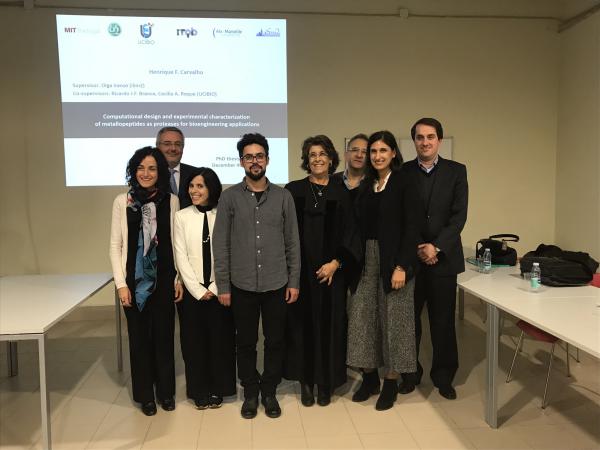
Congratulations to our PhD student Henrique Carvalho for completing the PhD program from MIT Portugal in Bioengineering Systems.

Henrique Daniel Figueiredo Carvalho

Title: 

Anything but conventional chromatography Workshop

The Workshop ABC2 "Anything but conventional chromatography" organised by our group and held in Lisbon last week (22-24th November) has been a success!

Thanks to all participants!

Congratulations to our Master Students 2017

Congratulations to our 3 master students who sucessfully defended their Master Thesis during this last month!

Palma, SICJ, Roque ACA.  2017.  Hybrid Magnetic-Polymeric Iron Oxide Nanoprobes for Magnetic Resonance Imaging. Journal of Nanoscience and Nanotechnology. Volume 17(Number 7):4410-4431(22). AbstractWebsite

In the last decades, the advent of nanotechnology has driven the study and application of nanoscale versions of magnetic materials. Among the various nanoparticles under research, iron oxide magnetic nanoparticles (MNP), namely iron oxides magnetite (Fe3O4) and maghemite (γ-Fe2O3), have attracted particular interest due to their superparamagnetism, biocompatibility and biodegradability. MNP are thus ideal platforms to work on a cellular and molecular level in several biomedical applications. In particular, the use of MNP as contrast agents for biomedical imaging through Magnetic Resonance Imaging (MRI) has been explored extensively in the last 30 years, taking advantage of the versatility of MNP functionalization due to the available large surface-to-volume ratio. Polymers, either synthetic or natural, are the most common class of materials employed as coatings for MNP, allowing to customize nanoprobes properties such as size, shape, magnetic relaxation, as well as cell-nanoprobe interactions (for example, specificity towards tissue types, responsiveness to cellular environment features), therapeutic effects or combination with other imaging modalities. While most biopolymers have intrinsic biocompatibility and biodegradability properties and are greener products, synthetic polymers offer engineering versatility and possibility of being tailor-made with specific properties. This review covers the properties of nanoscale iron oxides, production and stabilization methods of such nanoparticles, and their biomedical applications, mainly focusing on the engineering of polymeric-MNP assemblies towards the development of new hybrid magnetic-polymeric MRI nanoprobes.

Fernandes, CSM, Pina AS, Batalha ÍL, Roque ACA.  2017.  Magnetic fishing of recombinant green fluorescent proteins and tagged proteins with designed synthetic ligands. Separation Science and Technology. AbstractWebsite

Biomimetic ligands have emerged to overcome disadvantages inherent in biological ligands. In particular, the Ugi reaction can generate scaffolds where molecular diversity can be introduced, allowing the synthesis and screening of ligand libraries in a high-throughput manner against a variety of biological targets. Two adsorbents bearing Ugi-based synthetic ligands, coined A4C7 and A7C1, were previously developed for the selective recovery of green fluorescent protein (GFP) and RKRKRK-tagged GFP directly from Escherichia coli crude extracts. This work describes, for the first time, the in situ synthesis of Ugi-based ligands on magnetic beads and their application in the magnetic recovery of cognate proteins.

Outreach at the secondary school ESPAM

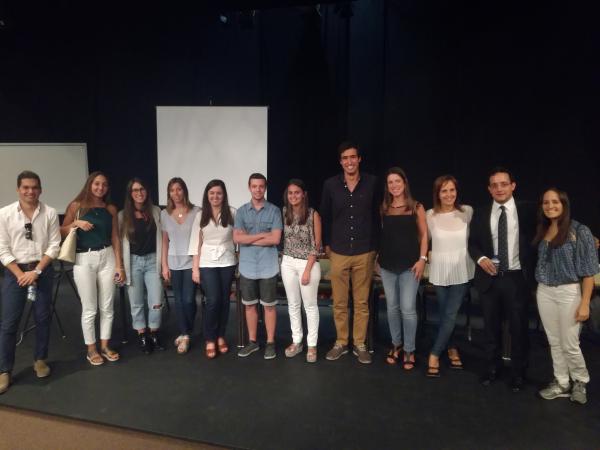
Ana Carolina Pádua participated in an outreach at the secondary school ESPAM, in Vila Nova de Santo André, on 15th September 2017. Ana Carolina spoke about her academic pathway, and the Master in Biomedical Engineering at FCT-UNL. Also, she presented her current PhD project, as well as the prototypes of Electronic Nose developed so far.