xtal

Santos, MFA, Correia I, Oliveira AR, Garribba E, Pessoa JC, Santos-Silva T.  2014.  Vanadium Complexes as Prospective Therapeutics: Structural Characterization of a VIV Lysozyme Adduct. European Journal of Inorganic Chemistry. :n/a–n/a.: WILEY-VCH Verlag AbstractWebsite

The biological activity of vanadium complexes, namely, as insulin enhancers, is well known. We report a combined X-ray crystallography, electron paramagnetic resonance, and density functional theory study of the interaction of vanadium picolinate complexes with hen egg white lysozyme (HEWL). We show that the VIVO(pic)2 complex covalently binds to the COO– group of the side chain of Asp52 of HEWL. The long VIV=O bond obtained in the X-ray study is explained to be due to reduction of VIV to VIII during exposure of the crystals to the intense X-ray beam.

Pessoa, JC, Gonçalves G, Roy S, Correia I, Mehtab S, Santos MFA, Santos-Silva T.  2014.  New insights on vanadium binding to human serum transferrin. Inorganica Chimica Acta. 420:60-68. AbstractWebsite

Abstract The knowledge on the binding of vanadium ions and complexes to serum proteins and how vanadium might be transported in blood and up-taken by cells has received much attention during the last decade, particularly as far as the transport of VIVO2+ is concerned. In this work we revise and discuss some relevant aspects of previous research, namely the two main types of binding proposed for transport of VIVO(carrier)2 complexes. New results, obtained by circular dichroism (CD), \{EPR\} and gel electrophoresis, regarding the binding of vanadium to hTF in the oxidation states +5 and +3 are also presented. Namely, evidences for the binding of VV-species to diferric-transferrin, designated by (FeIII)2hTF, as well as to (AlIII)2hTF, are presented and discussed, the possibility of up-take of vanadate by cells through (FeIII)2hTF endocytosis being suggested. It is also confirmed that \{VIII\} binds strongly to hTF, forming di-vanadium(III)-transferrin, designated by (VIII)2hTF, and gel electrophoresis experiments indicate that (VIII)2hTF corresponds to a ‘closed conformation’ similar to (FeIII)2hTF.

Best Poster Award by The International Organization for Biological Crystallization

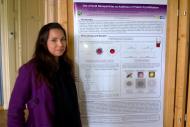
 On June 23rd, Diana Ribeiro, from the Macromolecular Crystallography & GlycoLab Group at FCT-UNL, was awarded the Prize for Best Poster entitled “Use of Gold Nanoparticles as Additives in Protein Crystallization”, by The International Organization for Biological Crystallization, in the 1st FEBS-INSTRUCT Practical Crystallization Course, Advanced Methods in Macromolecular Crystallization VI, that t

Verma, AK, Goyal A, Freire F, Bule P, Venditto I, Bras JLA, Santos H, Cardoso V, Bonifacio C, Thompson A, Romao MJ, Prates JAM, Ferreira LMA, Fontes CMGA, Najmudin S.  2013.  Overexpression, crystallization and preliminary X-ray crystallographic analysis of glucuronoxylan xylanohydrolase (Xyn30A) from Clostridium thermocellum. Acta Crystallographica Section F-Structural Biology and Crystallization Communications. 69:1440-1442. AbstractWebsite
n/a
Santos, MFA, Oliveira AR, Somnath R, Romao MJ, Pessoa JC, Santos-Silva T.  2013.  Vanadium compounds as prospective therapeutics: X-ray structure of protein adducts. European Biophysics Journal with Biophysics Letters. 42:S181-S181. AbstractWebsite
n/a
Romao, MJ.  2013.  Unraveling new functions and modes of action of molybdenum-dependent enzymes. European Biophysics Journal with Biophysics Letters. 42:S35-S35. AbstractWebsite
n/a
Pinheiro, BA, Carvalho AL, Romao MJ, Fontes CM.  2013.  Study of the cohesin-dockerin interaction and its role in the C. thermocellum cellulosome assembly. European Biophysics Journal with Biophysics Letters. 42:S180-S180. AbstractWebsite
n/a
Palma, AS, Pinheiro B, Liu Y, Takeda Y, Chai W, Ito Y, Romao MJ, Carvalho AL, Feizi T.  2013.  The Structural Basis of the Recognition of Di-glucosylated N-glycans by the ER Lectin Malectin. Glycobiology. 23:1368-1369., Number 11 AbstractWebsite
n/a
Otrelo-Cardoso, AR, Schwuchow V, Rodrigues D, Cabrita EJ, Leimkuehler S, Romao MJ, Santos-Silva T.  2014.  Biochemical, Stabilization and Crystallization Studies on a Molecular Chaperone (PaoD) Involved in the Maturation of Molybdoenzymes. Plos One. 9, Number 1 AbstractWebsite
n/a
Otrelo-Cardoso, AR, da Silva Correia MA, Schwuchow V, Svergun DI, Romao MJ, Leimkuehler S, Santos-Silva T.  2014.  Structural Data on the Periplasmic Aldehyde Oxidoreductase PaoABC from Escherichia coli: SAXS and Preliminary X-ray Crystallography Analysis. International Journal of Molecular Sciences. 15:2223-2236., Number 2 AbstractWebsite
n/a
Mukhopadhyay, A, Bursakov SA, Ramos JL, Wittich RM, Kladova AV, Romao MJ, van Dillewijn P, Carvalho AL.  2013.  Determinants of selective group reduction in the TNT-bound xenobiotic reductase B from P. putida. European Biophysics Journal with Biophysics Letters. 42:S179-S179. AbstractWebsite
n/a
Marangon, J, Correia HD, Brondino CD, Moura JJG, Romao MJ, Gonzalez PJ, Santos-Silva T.  2013.  Kinetic and Structural Studies of Aldehyde Oxidoreductase from Desulfovibrio gigas Reveal a Dithiolene-Based Chemistry for Enzyme Activation and Inhibition by H2O2. Plos One. 8, Number 12 AbstractWebsite
n/a
Mahro, M, Bras NF, Cerqueira NMFSA, Teutloff C, Coelho C, Romao MJ, Leimkuehler S.  2013.  Identification of Crucial Amino Acids in Mouse Aldehyde Oxidase 3 That Determine Substrate Specificity. Plos One. 8, Number 12 AbstractWebsite
n/a

Meeting IUCr2014 - Montréal, Canada

Date: 
Tuesday, August 5, 2014, 12:00am - Tuesday, August 12, 2014, 12:20pm

http://iucr2014.org

1st PCISBIO Day @ ITQB, Oeiras

Date: 
Monday, July 7, 2014 (All day)

http://xtal.dq.fct.unl.pt/PCISBIO/Events.html

Main purposes of the meeting:

- to show and disseminate some of our successful use and participation in the Instruct programs;

-to motivate our Portuguese colleagues to think and act in terms of a Portuguese SB infrastructure as PCISBIO.

Expo IYCr2014 Crystallography for Human Kind

Date: 
Monday, June 23, 2014, 6:30pm

Átrio do Edifício VII da FCT, campus de Caparica

Lecture IYCr2014

Date: 
Monday, June 23, 2014, 5:00pm
Professor Robert Huber was born in 1937 in Munich. He studied chemistry at the Technische Universität München (TUM), where he also completed his Ph.D. and habilitation. Since 1972, he has been a member of the Max-Planck-Gesellschaft and Director at the Max-Planck-Institut für Biochemie until his retirement in 2005. Since 1976, he also serves at the TUM as a Professor. He holds appointments as Guest Professor at the Universität Duisburg-Essen (Germany), the Cardiff University (Great Britain), and the Universidad Autonoma de Barcelona (Spain).