Susana Palma attended the 2nd International Workshop on Magnetic Particle Imaging, Lübeck (Germany), March 15/16, 2012 (site: http://www.iwmpi.uni-luebeck.de/)
Affinity chromatography with protein A from Staphylococcus aureus (SpA) is the most widespread and
accepted methodology for antibody capture during the downstream process of antibody manufacturing.
A triazine based ligand (ligand 22/8) was previously developed as an inexpensive and robust alternative
to SpA chromatography (Li et al. [12] and Teng et al. [11]). Despite the experimental success, there is no
structural information on the binding modes of ligand 22/8 to antibodies, namely to Immunoglobulin G
(IgG) molecules and fragments. In this work, we addressed this issue by a molecular docking approach
allied to molecular dynamics simulations. Theoretical results confirmed the preference of the synthetic
ligand to bind IgG through the binding site found in the crystallographic structure of the natural complex
between SpA and the Fc fragment of IgG. Our studies also suggested other unknown “hot-spots” for
specific binding of the affinity ligand at the hinge between VH and CH1 domains of Fab fragment. The best
docking poses were further analysed by molecular dynamics studies at three different protonation states
(pH 3, 7 and 11). The main interactions between ligand 22/8 and the IgG fragments found at pH 7 were
weaker at pH 3 and pH 11 and in these conditions the ligand start losing tight contact with the binding
site, corroborating the experimental evidence for protein elution from the chromatographic adsorbents
at these pH conditions.
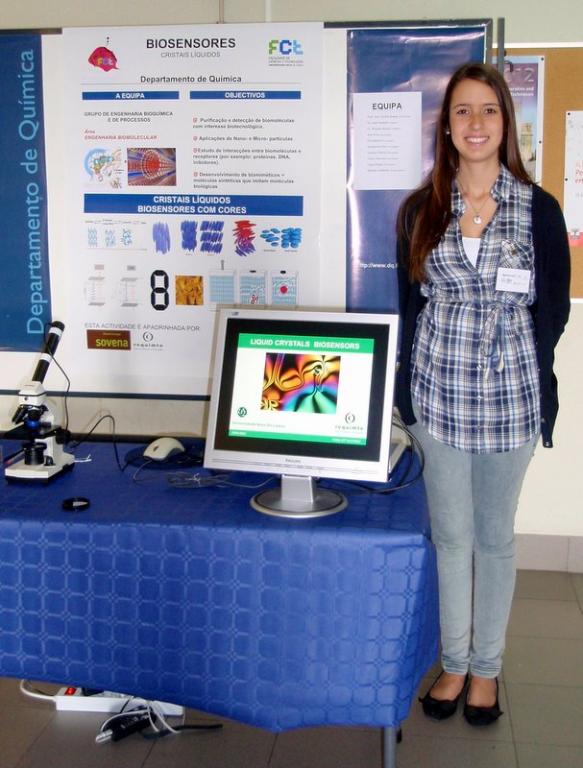
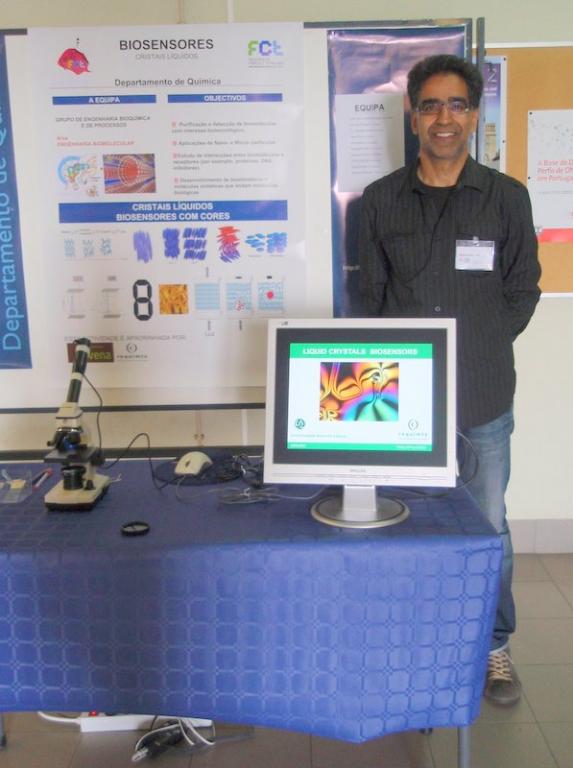
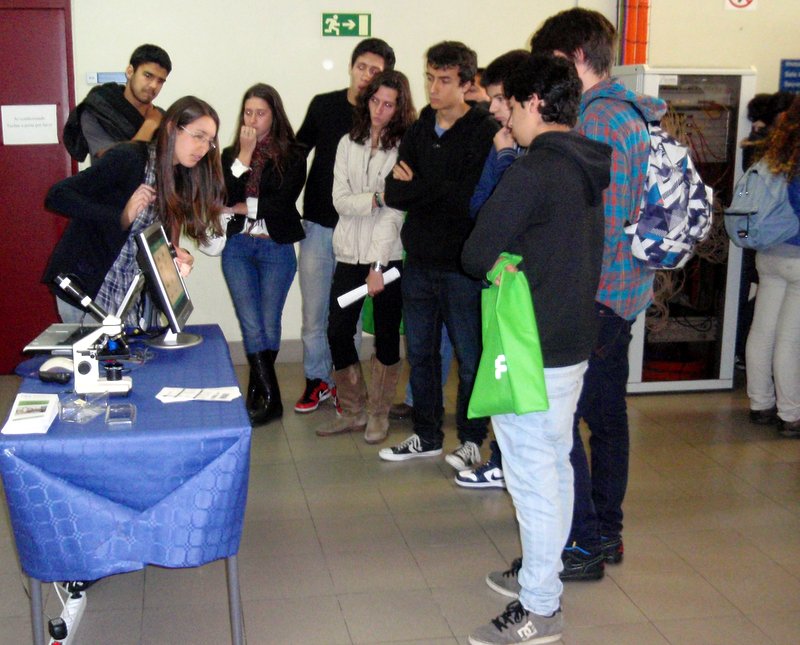
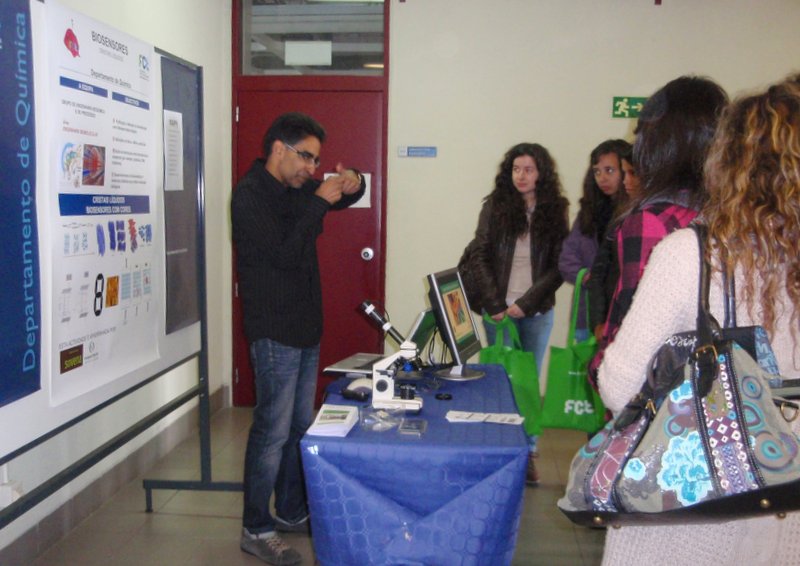
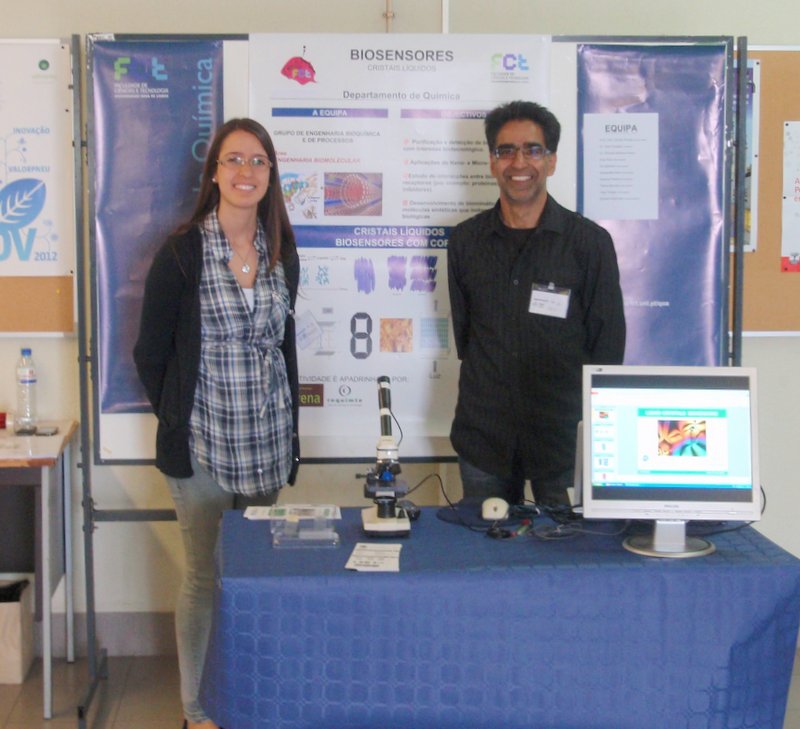
The Faculty´s annual EXPO-FCT was held this year on Friday 13th April 2012. EXPO is a public event organised every year to highlight the Faculty´s cutting edge research programmes. The Chemistry Department showcased a multitude of exhibitions in the form of demonstrations and interactive experiments. The Biomolecular Engineering Group featured strongly with its Liquid Crystal Biosensors exhibition.
Fluorescence microscopy and microspectrofluorometry are important tools in the characterization and identification of proteins, offering a great range of applications in conservation science. Because of their high selectivity and sensitivity, the combination of these techniques can be exploited for improved recognition and quantification of proteinaceous binders in paintings and polychromed works of art. The present article explores an analytical protocol integrating fluorescence microscopy and fluorometry for both identification and mapping of proteinaceous binders (in particular egg and glues) in paint samples. The study has been carried out on historically accurate reconstructions simulating the structure and composition of tempera and oil paints containing these binders. To assess the spatial distribution of specific proteins within the paint layers, cross-sections from the reconstructions were analyzed by fluorescence imaging after staining with an exogenous fluorophore. Reference fluorescence spectra for each layer were acquired by a multichannel spectral analyzer and compared after Gaussian deconvolution. The results obtained demonstrated the effectiveness of the integrated protocol, highlighting the potential for the use of fluorescent staining coupled with microspectrofluorometry as a routine diagnostic tool in conservation science. The current work creates a set of fully characterized reference samples for further comparison with those from actual works of art.
Protein phosphorylation is a complex and highly dynamic process involved in numerous biological events. Abnormal phosphorylation is one of the underlying mechanisms for the development of cancer and metabolic disorders. The identification and absolute quantification of specific phospho-signatures can help elucidate protein functions in signaling pathways and facilitate the development of new and personalized diagnostic and therapeutic tools. This review presents a variety of strategies currently utilized for the enrichment of phosphorylated proteins and peptides before mass spectrometry analysis during proteomic studies. The investigation of specific affinity reagents, allied to the integration of different enrichment processes, is triggering the development of more selective, rapid and cost-effective high-throughput automated platforms.
The group received funding from Fundação para a Ciência e a Tecnologia for the project "Viral Capture and Purification System: Smart macroporous structures for the affinity purification of retroviral particles", lead by Cecília Roque in collaboration with IBET.
The project “Affinity Layering - An Innovative Approach Towards Cancer Theranostics”, by Ana Cecília Roque, Ana Pina, Íris Batalha and Susana Palma received a honorable mention in the competition SHIC'11 - Solvay & Hovione Innovation Challenge.
Drug Discovery in modern times straddles three main periods. The first notable period can be traced to the nineteenth century where the basis of drug discovery relied on the serendipity of the medicinal chemists. The second period commenced around the early twentieth century when new drug structures were found, which contributed for a new era of antibiotics discovery. Based on these known structures, and with the development of powerful new techniques such as molecular modelling, combinatorial chemistry, and automated high-throughput screening, rapid advances occurred in drug discovery towards the end of the century. The period also was revolutionized by the emergence of recombinant DNA technology, where it became possible to develop potential drugs target candidates. With all the expansion of new technologies and the onset of the "Omics" revolution in the twenty-first century, the third period has kick-started with an increase in biopharmaceutical drugs approved by FDA/EMEA for therapeutic use.
Synthetic affinity ligands can circumvent the drawbacks of natural immunoglobulin (Ig)-binding proteins by imparting resistance to chemical and biochemical degradation and to in situ sterilization, as well as ease and low cost of production. Protein L (PpL), isolated from Peptostreptococcus magnus strains, interacts with the Fab (antigen-binding fragment) portion of Igs, specifically with kappa light chains, and represents an almost universal ligand for the purification of antibodies. The concepts of rational design and solid-phase combinatorial chemistry were used for the discovery of a synthetic PpL mimic affinity ligand. The procedure presented in this chapter represents a general approach with the potential to be applied to different systems and target proteins.
Biomolecule separation and purification has until very recently steadfastly remained one of the more empirical aspects of modern biotechnology. Affinity chromatography, one of several types of adsorption chromatography, is particularly suited for the efficient isolation of biomolecules. This technique relies on the adsorbent bed material that has biological affinity for the substance to be isolated. This review is intended to place affinity chromatography in historical perspective and describe the current status, limitations and future prospects for the technique in modern biotechnology.