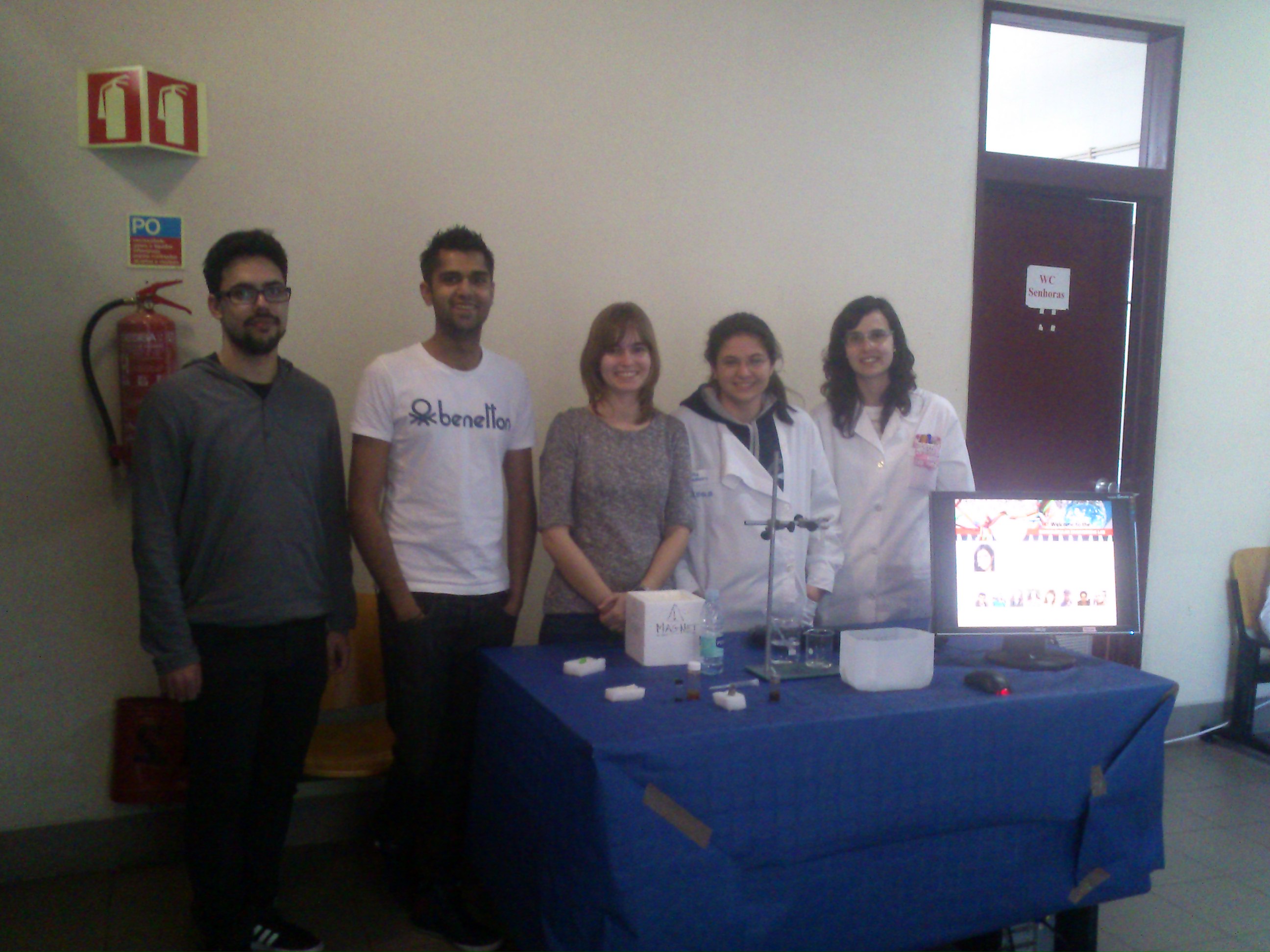
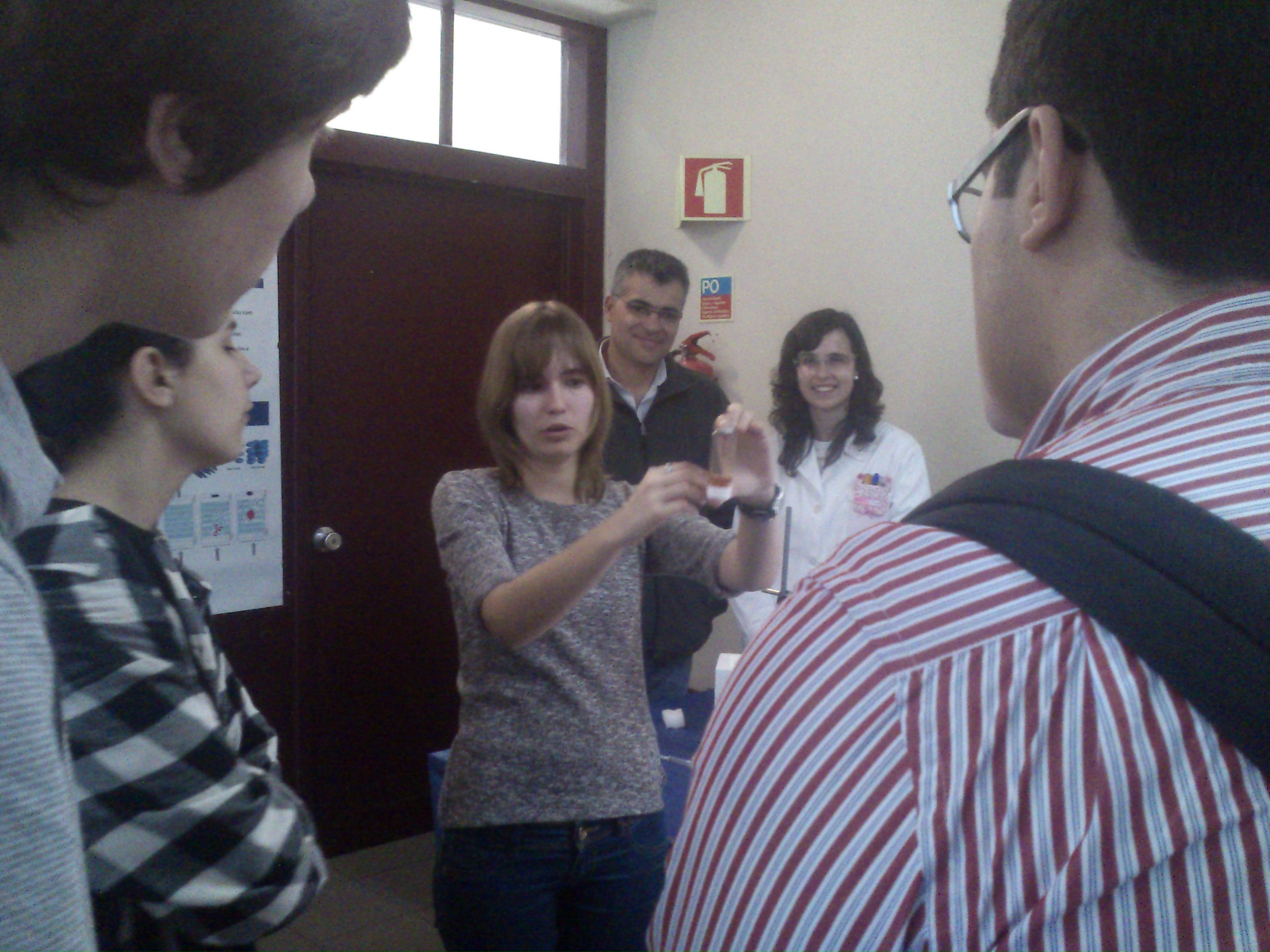
The Crystal Sense team, composed by Prof. Ana Cecília Roque, Ana Margarida Dias, Ana Sofia Pina and Ricardo Branco, was interviewed by the TV program "Exame Informática", as a result of the participation in coHItech program.
The reversible interaction between an affinity ligand and a complementary receptor has been widely explored in purification systems for several biomolecules. The development of tailored affinity ligands highly specific towards particular target biomolecules is one of the options in affinity purification systems. However, both genetic and chemical modifications on proteins and peptides widen the application of affinity ligand-tag receptor pairs towards universal capture and purification strategies. In particular, this chapter will focus on two case studies highly relevant for biotechnology and biomedical areas, namely, the affinity tags and receptors employed on the production of recombinant fusion proteins and the chemical modification of phosphate groups on proteins and peptides and the subsequent specific capture and enrichment, a mandatory step before further proteomic analysis.
FucoPol, a fucose-containing extracellular polysaccharide (EPS) produced by bacterium Enterobacter A47 using glycerol as the carbon source, was employed as a coating material for magnetic particles (MPs), which were subsequently functionalized with an artificial ligand for the capture of antibodies. The performance of the modified MPs (MP–EPS-22/8) for antibody purification was investigated using direct magnetic separation alone or combined with an aqueous two-phase system (ATPS) composed of polyethylene glycol (PEG) and dextran. In direct magnetic capturing, and using pure protein solutions of human immunoglobulin G (hIgG) and bovine serum albumin (BSA), MP–EPS-22/8 bound 120 mg hIgG g−1 MPs, whereas with BSA only 10 ± 2 mg BSA g−1 MPs was achieved. The hybrid process combining both the ATPS and magnetic capturing leads to a good performance for partitioning of hIgG in the desired phase as well as recovery by the magnetic separator. The MPs were able to bind 145 mg of hIgG g−1 of particles which is quite high when compared with direct magnetic separation. The theoretical maximum capacity was calculated to be 410 ± 15 mg hIgG adsorbed g−1 MPs with a binding affinity constant of 4.3 × 10⁴ M−1. In multiple extraction steps, the MPs bound 92% of loaded hIgG with a final purity level of 98.5%. The MPs could easily be regenerated, recycled and re-used for five cycles with only minor loss of capacity. FucoPol coating allowed both electrostatic and hydrophobic interactions with the antibody contributing to enhance the specificity for the targeted products.
The green fluorescent protein (GFP) is widely employed to report on a variety of molecular phenomena, but its selective recovery is hampered by the lack of a low-cost and robust purification alternative. This work reports an integrated approach combining rational design and experimental validation toward the optimization of a small fully-synthetic ligand for GFP purification. A total of 56 affinity ligands based on a first-generation lead structure were rationally designed through molecular modeling protocols. The library of ligands was further synthesized by solid-phase combinatorial methods based on the Ugi reaction and screened against Escherichia coli extracts containing GFP. Ligands A4C2, A5C5 and A5C6 emerged as the new lead structures based on the high estimated theoretical affinity constants and the high GFP binding percentages and enrichment factors. The elution of GFP from these adsorbents was further characterized, where the best compromise between mild elution conditions, yield and purity was found for ligands A5C5 and A5C6. These were tested for purifying a model GFP-fusion protein, where ligand A5C5 yielded higher protein recovery and purity. The molecular interactions between the lead ligands and GFP were further assessed by molecular dynamics simulations, showing a wide range of potential hydrophobic and hydrogen-bond interactions.