Projects
Check our booklet!

O Projeto AdAM tem como objetivo desenvolver uma plataforma de automação avançada que acompanhe a complexidade de processos presentes nas diferentes fases de produção e as exigências dos requisitos necessários para introduzir novos comportamentos adaptativos nas indústrias de manufatura modernas. O projeto AdAM criará uma plataforma de automação genérica, integrando e harmonizando métodos, processos e sistemas padronizados e emergentes no mundo da automação (IEC61499, IEC62541-OPC UA), assim como estruturas de código aberto (openMOS, ROS Industrial, AutomationML e Eclipse 4diac). Inclui, nomeadamente, um sistema de inspeção de Ensaios Não Destrutivos (END) com Correntes Induzidas (CI) para a inspeção de soldaduras brasadas a laser para a indústria automóvel..
Partners: INTROSYS – INTEGRATION FOR ROBOTIC SYSTEMS, S.A., UNIVERSIDADE NOVA DE LISBOA – FACULDADE DE CIÊNCIAS E TECNOLOGIA (FCT NOVA), VOLKSWAGEN AUTOEUROPA, LDA, CEIIA – CENTRO PARA EXCELÊNCIA E INOVAÇÃO NA INDÚSTRIA AUTOMÓVEL..
Funding organization: Fundo Europeu de Desenvolvimento Regional - FEDER

Reference:18/SI/2018 N.° 045117
Start date: 01/10/20219
End date: 30/09/2022
Main researcher:Telmo dos Santos, Full Professor
Research group:Manufacturing Technologies and Automation

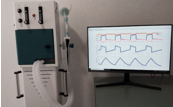
O projeto MiniVent tem como objetivo desenvolver a evolução do conceito de ventilador minimalista para ventilação mecânica intrusiva, em modo de controlo de pressão, para a terapia clínica intensiva de emergência do COVID 19 com uma arquitetura única mas com várias alternativas em termos dos componentes possíveis de usar, em função da sua disponibilidade de mercado ou capacidade local de produção.
Partners: UNIVERSIDADE NOVA DE LISBOA – FACULDADE DE CIÊNCIAS E TECNOLOGIA (FCT NOVA), UNIVERSIDADE NOVA DE LISBOA – NOVA MEDICAL SCHOOL, ME & You Innovative, S.A.
Funding organization: Fundo Europeu de Desenvolvimento Regional - FEDER
Objetivo: O projeto MiniVent tem como objetivo desenvolver a evolução do conceito de ventilador minimalista para ventilaçã o mecânica intrusiva, em modo de controlo de pressão, para a terapia clínica intensiva de emergência do COVID 19 com uma arquitetura única mas com várias alternativas em termos dos componentes possíveis de usar, em função da sua disponibilidade de mercado ou capacidade local de produção.
Reference:15/SI/2020 N.° 057250
Start date: 11/08/2020
End date: 12/10/2021
Main researcher:Telmo dos Santos, Assistant Professor
Research group:Manufacturing Technologies and Automation

O Projeto Caravela consiste em desenvolver e demostrar, de forma integrada, tecnologia para os principais building blocks que constituem um microlançador, a partir das capacidades que já existem em Portugal nestas áreas
A FCT NOVA contribui para este projeto com o Sistema de propulsão líquida (líquido-líquido), com tanques e atuadores associados e a modelação do controlo vetorial.
Partners: TEKEVER SPACE, Sistemas Espaciais, Lda; Aeroclube de Torres Vedras; CEIIA - Centro de Engenharia e Desenvolvimento; Faculdade de Engenharia da Universidade do Porto; FHP - Frezite High Performance, Lda; Instituto de Soldadura e Qualidade; Instituto Superior Técnico; OMNIDEA LDA; UNIVERSIDADE NOVA DE LISBOA – FACULDADE DE CIÊNCIAS E TECNOLOGIA (FCT NOVA); USIMECA-METALOMECÂNICA LDA.
Funding organization: Fundo Europeu de Desenvolvimento Regional - FEDER
Objetivo: O Projeto Caravela consiste em desenvolver e demostrar, de forma integrada, tecnologia para os principais building blocks que constituem um microlançador, a partir das capacidades que já existem em Portugal nestas áreas.
Reference:31/SI/2017 Nº 39796
Start date: 03/09/2019
End date: 02/09/2022
Main researcher:Telmo dos Santos, Assistant Professor
Research group:Manufacturing Technologies and Automation

O Projeto PROBING consiste na criação de um produto inovador para a deteção de defeitos em juntas brasadas por laser utilizando técnicas de inspeção e ensaios não destrutivos. A FCT NOVA contribui para este projeto com o desenho e a conceção das sondas miniaturizadas para inspeção de juntas brasadas por laser e com a realização de testes de validação preliminares e em ambiente real do mecanismo de inspeção.
Partners: INTROSYS – Integration for Robotic Systems, S.A.; Universidade Nova de Lisboa – Faculdade de Ciências e Tecnologia (FCT NOVA); Volkswagen Autoeuropa, Lda.
Funding organization: Fundo Europeu de Desenvolvimento Regional - FEDER
Objetivo: O Projeto PROBING consiste na criação de um produto inovador para a deteção de defeitos em juntas brasadas por laser utilizando técnicas de inspeção e ensaios não destrutivos.
Reference:31/SI/2017 N.° 040042
Start date: 01/04/2019
End date: 30/11/2021
Main researcher:Telmo dos Santos, Assistant Professor
Research group:Manufacturing Technologies and Automation
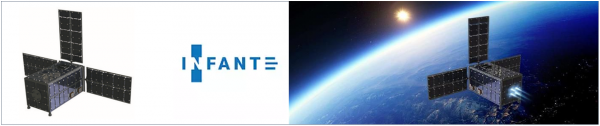
O presente projeto visa o desenvolvimento e demostração em órbita de um microssatélite modular e de baixo custo, como primeiro componente de uma constelação para a vigilância marítima, observação da Terra e comunicação entre satélites e estações terrestres. O microssatélite estará equipado com um sistema de comunicações rádio; um sistema de propulsão para possibilitar alterar a órbita; painéis solares orientados e uma baía de carga com sensores para experiencias científicas e validação tecnológica como SAR e câmara multiespectral. A FCT NOVA contribui para este projeto com o desenvolvimento, realização e pré-inspeção da Soldadura orbital por Fricção Linear (SFL) dos tanques de combustível do satélite.
Partners: ISPT, Tekever Asds, Lda; Active Space Technologies – Actividades Aeroespaciais, Sa; Ceiia – Centro De Engenharia E Desenvolvimento;Instituto De Soldadura E Qualidade; Omnidea Lda; Tekever Iii Communication Systems, Lda; Tekever Space – Sistemas Espaciais, Lda; Universidade Do Porto; Active Aerogels, Lda; Universidade Nova De Lisboa – Faculdade De Ciências E Tecnologia (Fct Nova); Gmvis Skysoft, S.A.; Hps High Performance Structures Gestão E Engenharia, Lda; Laboratório Ibérico Internacional De Nanotecnologia (Lin); Instituto Pedro Nunes – Associação Para A Inovação E Desenvolvimento Em Ciência E Tecnologia; Instituto Politécnico De Tomar; Instituto Superior Técnico; Instituto De Telecomunicações; Spin.Works S.A.; Universidade Da Beira Interior
Funding organization: Fundo Europeu de Desenvolvimento Regional - FEDER
Objetivo: Reforçar a investigação, o desenvolvimento tecnológico e a inovação.
Reference:10/SI/2016 N.°024534
Start date: 01 Nov 2017
End date: 31 Oct 2020
Main researcher:Telmo dos Santos, Assistant Professor
Research group:Manufacturing Technologies and Automation
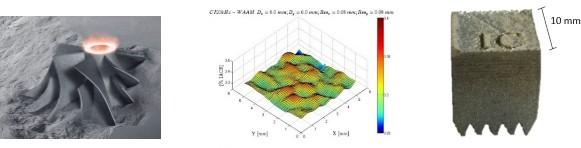
O presente projeto tem como objetivo o desenvolvimento de um equipamento/ferramenta para fabricação aditiva de peças/componentes metálicos de grandes dimensões recorrendo à tecnologia laser para o processo de união dos pós metálicos. Pretende-se que este equipamento se aplique a nível industrial (ramo automóvel e aeronáutico) e seja capaz de fabricar peças de elevada dimensão (volume de trabalho de 0,9 m3) com um laser de fibras de 1 kW capaz de se mover a velocidades de modo a produzir 40 cm3 de material sinterizado/fundido por hora (40 cm3/h).
Partners: ISPT, Adira – Metal Forming Solutions, Sa; Inegi – Instituto De Ciências E Inovação Em Engenharia Mecânica E Engenharia Industrial; Instituto Superior Técnico; Universidade Nova De Lisboa – Faculdade De Ciências E Tecnologia (Fct Nova); Manuel Da Conceição Graça, Limitada
Funding organization: Fundo Europeu de Desenvolvimento Regional - FEDER
Objetivo: Reforçar a investigação, o desenvolvimento tecnológico e a inovação
Atividades: Contribuição para o desenvolvimento e otimização de um equipamento de fusão seletiva por laser de metais através das caracterizações microestruturais e do comportamento mecânico
Reference:08/SI/2015 N.°003346
Start date: 01 Jun 2016
End date: 31 May 2019
Main researcher:Telmo dos Santos, Assistant Professor
Research group:Manufacturing Technologies and Automation

O projeto Hi2TRUST constitui um segundo ciclo de desenvolvimento, iniciado em 2013 com o projeto HITRUST, de um sistema avançado de inspeção e monitorização de componentes críticos em serviço, nas condições operacionais de alta temperatura, até aos 550ºC. O presente projeto visa ultrapassar as limitações físicas da tecnologia de inspeção EMAT (Electromagnetic Accoustic Transducers) identificadas pelo consórcio no projeto HiTRUST. Neste contexto, foram desenvolvidas outras técnicas de inspeção por Ultra-sons avançados, por Correntes Induzidas e desenvolvido um módulo de inspeção visual automatizado. Fazem parte deste projeto as vertentes de inspeção volumétrica, utilizando o Phased Array, inspeção superficial, utilizando as Correntes Induzidas e Inspeção Visual remota utilizando câmaras avançadas de alta definição e um sistema de alinhamento laser. A integração destas técnicas tem um caracter complementar com as restantes, conseguindo-se assim maximizar a sensibilidade e capacidade de deteção do sistema. O resultado da integração destas tecnologias consiste num produto que integra aspetos de inovação combinando várias técnicas avançadas de controlo não destrutivo que permite inspecionar todos os defeitos típicos dos componentes alvos nas referidas condições de serviço a alta temperatura.
Partners: ISPT, The Navigator Company, ISQ, FCT UNL
Funding organization: Fundo Europeu de Desenvolvimento Regional - FEDER
Objetivo: O presente projeto visa ultrapassar as limitações físicas da tecnologia de inspeção EMAT (Electromagnetic Accoustic Transducers) identificadas pelo consórcio no projeto HiTRUST.
Atividades: Desenvolvimento e validação experimental de sondas de correntes induzidas para a inspeção de tubagens a alta temperatura (300°C – 500°C).
Reference:08/SI/2015 N.°3335
Start date: 01 Apr 2016
End date: 31 Mar 2018
Main researcher:Telmo dos Santos, Assistant Professor
Research group:Manufacturing Technologies and Automation
Defects Detection in Microfabrication with
Bacterial Cells (MicroBac)

This project aims to develop and apply a new Non-Destructive Testing (NDT) method for microfabrication components based on bacterial film cells. It is envisaged to use the dimension, mobility, fluorescence and adherence of bacterial cells to identify defects in micro manufactured components. In fact bacterial cells adhere to surfaces irregularities as roughness, cracks, voids, cleavages and low pressure points. For this four strategies will be considered involving: 1 - Color, fluorescent and exothermal bacteria 2 - Bacteria with electrical properties 3 - Bacteria with magnetic properties 4 - Antibacterial agent as developer Each of these strategies comprises a set of stages such as: 1) identification and localization of inspection zone; 2) surface cleaning; 3) application of bacterial cells suspension; 4) penetration and cell adherence; 5) excess removal; 6) developing; 7) inspection; 8) final cleaning and sterilization. In stage 4 a set of different procedures is considered depending on the selected bacterial cells properties.
Partners: FCT-UNL, FCT-UC, IST, UNIDEMI, IBB
Funding organization: Fundação para a Ciência e a Tecnologia: FCT

Main achievements: A new NDT technique based on bacterial cell films for micro surface defects identification was developed. A suspension of bacterial cells proved to be adequate to reveal very small size surface defects in different materials. An experimental validation of the basic assumptions of the methodology was performed. It was seen that bacteria cells penetrate and adhere preferentially to defects, remaining inside the defect after mechanically removing the excess of bacteria. A detection limit was estimated for each material in 1-2 micron range. The depth to width ration was seen to be of major importance thus dye penetrant cannot compete with bacteria films but are complementary.
Reference:PTDC/EME-TME/118678/2010
Start date:02 Jan 2012
End date:30 Jun 2015
Main researcher:Telmo dos Santos, Assistant Professor
Research group:Manufacturing Technologies and Automation
Analysis of laser welding for nondestructive
process (NDT-LASER)
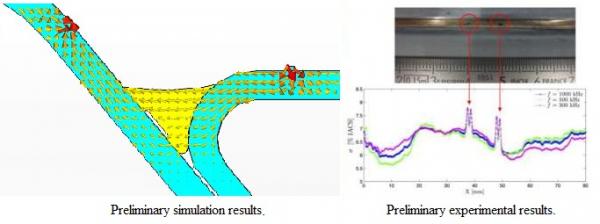
This project aims to develop and apply a customized Non-Destructive Testing (NDT) system comprising two distinct NDT techniques, complementary and redundant, in order to allow the identification of all types of defect morphologies possible to occur in the laser brazed welds, improving the reliability inspection. The NDT techniques are: Alternating Current Potential Drop Measurement (ACPDM) and eddy currents (EC).
Partners: FCT-UNL, UNIDEMI, INESC-MN
Funding organization: Autoeuropa (PT)

Main achievements: An integrated and customized NDT system constituted by: probes, chassis and the electronics for signal generation and acquisition, system control and software.
Reference:Within the frame of Body Shop Welding Department
Start date:01 Sep 2014
End date:01 Sep 2015
Main researcher:Rosa Miranda, Associate Professor with Habilitation
Research group:Manufacturing Technologies and Automation
Improved magnets for energy generation through
advanced tidal technology (MAGNETIDE)

This project aims to characterize magnetic samples produced by Powder Injection Moulding (PIM) specifically designed for tidal energy capture systems. The electrical properties were analyzed with different techniques: measurement of average electrical conductivity with both two-point technique and four-point technique, and also with eddy current technique. The electrical impedance profile of the samples were performed by eddy currents and the electrical conductivity profile were measured by a four-point probe. Magnetic properties were analyzed using the Hall Effect probe and morphological defects by X ray.
Partners: FCT-UNL, UNIDEMI, IST Funding organization: IST (PT) / 7FP
Project website: http://www.magnetide.eu/about/
Main achievements: Characterization of magnetic materials produced by Powder Injection Moulding (PIM).
Reference:284578 Funded under FP7-SME
Start date:01 Nov 2013
End date:01 Nov 2014
Main researcher:Telmo dos Santos, Assistant Professor
Research group:Manufacturing Technologies and Automation
Integrated Nano Sensor Probes and Electronics
for Eddy Currents Testing (INSPECT)

This project aims to develop a state of the art Non-Destructive Testing (NDT) system to overcome current testing limitations on some specific industrial applications. The system will include a new eddy currents probe, combining coils and a Magnetoresistive (MR) sensors array. Results will be displayed in a Graphical User Interface (GUI) running on a computer connected with the developed system. Characterization and testing on real and relevant NDT applications will evaluate the new system performance. Since the probe aims to be efficient for both superficial (requiring high frequency operation) and buried defects (requiring low frequency operation), coils have the disadvantage of having a frequency dependent sensitivity, which is lower at low frequencies. Moreover, coils also have a low spatial resolution, due to its millimeters range size.
Partners: FCT-UNL, INESC-MN
Funding organization: Fundação para a Ciência e a Tecnologia: FCT
Project website: http://www.inesc-id.pt/projects.php?pid=7452&Ano=10&prj=IP01039
Main achievements: A new NDT system for application to real non-destructive testing problems. The developed probe, electronics and final digital signal processing architecture performance on this applications will be compared with a commercial NDT system.
Reference:PTDC /EEI-PRO/3219/2012
Start date:01 May 2013
End date:01 May 2015
Main researcher:Telmo dos Santos, Assistant Professor
Research group:Manufacturing Technologies and Automation
Dedicated NDT system to detect LOP
root defects in FSW of AlMgSc alloys
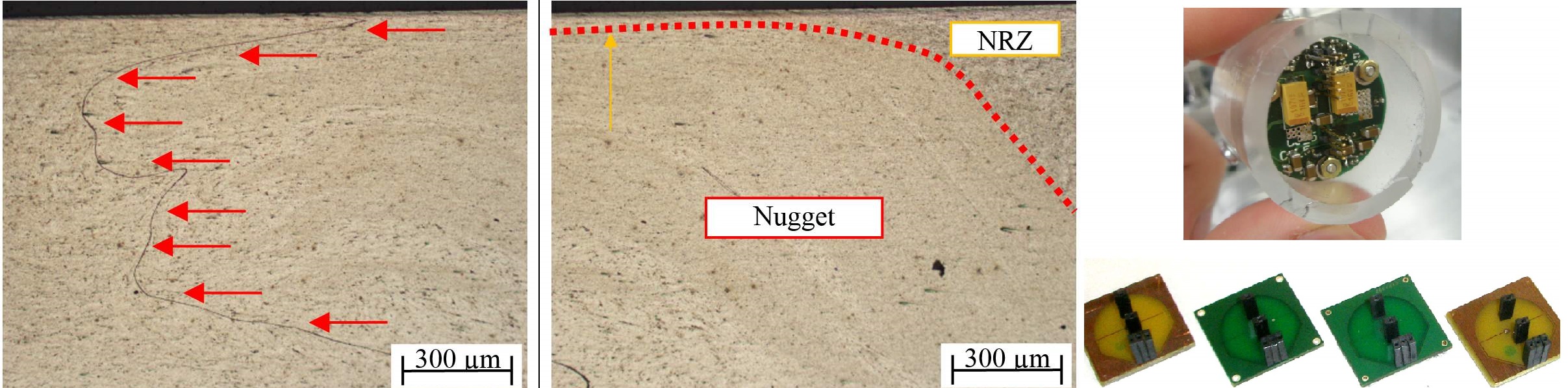
The overall objective was to develop a dedicated and reliable Non-Destructive Testing (NDT) system to detect Lack of Penetration (LOP) root defects in Friction Stir Welding (FSW) of AlMgSc alloys increasing limit threshold. The specific objectives were: i) Production and characterization of FSW specimens with different LOP ii) Optimization and production of the eddy current NDT IOnic Probes iii) Development and production of dedicated electronic and automated mechanical devices and software for FSW inspection iv) Experimental validation of the reliability of the entire NDT system The ultimate goal was to provide a functional semi-industrial prototype of the complete NDT system.
Partners: INESC, HZG (DE)
Reference:Within the frame of TP104 Metallic Fuselage
Start date:02 Jan 2012
End date:02 Jan 2014
Main researcher:Telmo dos Santos, Assistant Professor
Research group:Manufacturing Technologies and Automation