Glossary
This Glossary was developed to compile, clarify, and systematize key terminology related to coated fabrics, drawing on literature from multiple fields of expertise required to understand these materials. It is presented in alphabetical order in English (EN) and has been translated into Portuguese (PT) and French (FR). An expanded version of this Glossary will be published soon.
Produced with contributions from: Joana Tomás Ferreira, Gisela Ferreira, David Macário, Madalena Serro, Inês Soares, Mariana Passos, Susana França de Sá, Kim Verkens and Noémie Tournilhac.
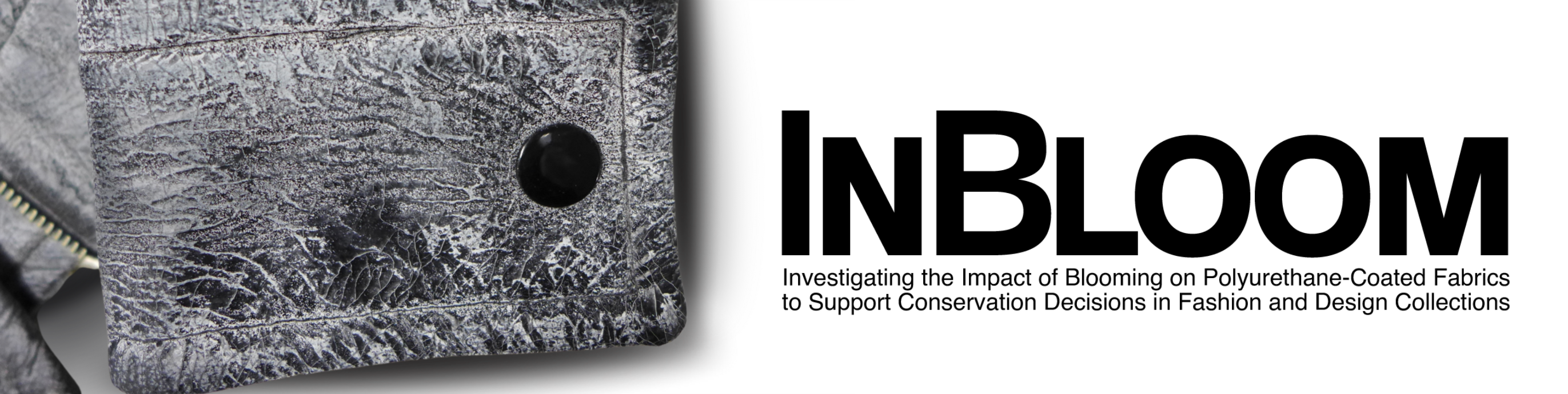
BLOOMING (EN) | EFLORESCÊNCIAS BRANCAS (PT) | EFFLORESCENCE (FR)
(EN) Blooming in coated fabrics refers to white, crystalline and/or waxy deposits on the surface of a coating. It can result from: a physical process, such as the migration of additives to the surface; and/or a chemical process, involving the formation of degradation products due to hydrolysis. In thermoplastic polyurethane (TPU) coatings, blooming has been identified as the primary deterioration pattern in the aromatic polyester-based class, typically composed of adipic acid.
(PT) Eflorescências brancas em tecidos revestidos refere-se ao aparecimento de depósitos brancos, com aparência cristalina e/ou cerosa, na superfície do revestimento. Em português, o termo “blooming” é também frequentemente mantido em textos técnicos.
Pode resultar de vários mecanismos: um processo físico, como a migração de aditivos para a superfície; e/ou um processo químico, envolvendo a formação de produtos de degradação devido a hidrólise. Em revestimentos de poliuretano termoplástico (TPU), o aparecimento destas eflorescências foi identificado como o principal padrão de deterioração de TPUs à base de poliéster aromático, sendo geralmente constituídas por ácido adípico.
(FR) Les efflorescences sur les textiles enduits désignent l'apparition de dépôts blancs cristallins et/ou cireux à la surface du revêtement. Il peut résulter d'un phénomène physique, comme une migration des additifs à la surface et/ou un phénomène chimique impliquant la formation de produits de dégradation par hydrolyse. Dans les revêtements en TPU (polyuréthane thermoplastique), les efflorescences ont été identifiées comme principal mode de dégradation pour les polyesters aromatiques, typiquement composés d'acide adipique.
COATING (EN) | REVESTIMENTO (PT) | APPRÊTAGE (FR)
(EN) In the coated fabrics context, coating is the process of covering a fabric or leather substrate, usually with a continuous natural or synthetic polymeric layer. "Coating" also defines this polymeric layer itself.
Coating layers can vary in number, thickness and morphology. Several application methods can be used, the most common ones being the direct and the transfer coating methods.
(PT) No contexto dos tecidos revestidos, revestimento é o processo de cobrir um substrato têxtil ou couro, geralmente com uma camada polimérica contínua, natural ou sintética. O termo “revestimento” também designa a própria camada polimérica.
As camadas de revestimento podem variar em número, espessura e morfologia. Podem ser utilizados vários métodos de aplicação, sendo os mais comuns os métodos de revestimento direto e por transferência.
(FR) Dans le domaine des textiles enduits, l'apprêtage consiste à recouvrir un support textile ou en cuir, généralement d'une couche polymère continue, naturelle ou synthétique. Le terme "apprêt" désigne également cette couche polymère elle-même.
Le nombre, l'épaisseur et la morphologie des couches d'apprêt peuvent varier. Plusieurs méthodes d'application sont possibles, les plus courantes étant l'apprêtage direct et l'apprêtage par transfert.
COATED FABRIC/COATED LEATHER (EN) | TECIDO REVESTIDO/COURO REVESTIDO (PT) | TEXTILES ENDUITS/CUIRS ENDUITS (FR)
(EN) Material composed of two or more layers, in which at least one is a fabric or leather substrate and at least one other is a substantially continuous polymeric layer with either a homogeneous or cellular structure, commonly made of TPU. The layers can be bonded together through their inherent adhesive properties or through an additional adhesive layer.
The coating layer(s) may serve decorative, functional, and/or protective purposes, resulting in coated fabrics with a wide range of aesthetic and tactile qualities, including leather-like textures, metallic, matte and highly glossy finishes.
(PT) Material composto por duas ou mais camadas, em que pelo menos uma é um substrato têxtil ou couro e outra é uma camada polimérica substancialmente contínua, com estrutura homogénea ou celular, geralmente à base de TPU. As camadas podem estar unidas através das suas propriedades adesivas intrínsecas ou por meio de uma camada adesiva adicional.
A(s) camada(s) de revestimento pode(m) ter funções decorativas, funcionais e/ou protetoras, resultando em tecidos revestidos com uma ampla variedade de qualidades estéticas e táteis, incluindo texturas semelhantes ao couro, acabamentos metálicos, mate e de elevado brilho.
(FR) Matériau composé d'au moins deux couches, dont au moins une est un substrat textile ou cuir et au moins une autre est une couche polymère essentiellement continue, à structure homogène ou cellulaire, généralement en TPU. Les couches peuvent être liées entre elles grâce à leurs propriétés adhésives intrinsèques ou par une couche adhésive supplémentaire.
La ou les couches de revêtement peuvent avoir des fonctions décoratives, fonctionnelles et/ou protectrices, permettant ainsi d'obtenir des textiles enduits présentant une large gamme de qualités esthétiques et tactiles, notamment des textures imitant le cuir, des finitions métalliques, mates et très brillantes.
DIRECT COATING METHOD (EN) | MÉTODO DE REVESTIMENTO DIRETO (PT) | MÉTHODE D'APPRÊTAGE DIRECT (FR)
(EN) One of the oldest, simplest, and most widely used techniques for applying coatings. The process involves the direct application and uniform spreading of a viscous coating compound (resin, solution, dispersion, paste, foam, or occasionally fine powder) onto a fabric or leather. In general, this method is only suitable to tightly woven fabrics, which can be pulled flat and held uniformly during coating, usually made from continuous-filament yarns like as polyamide or polyester. Cellulose-based fibres and stretchy knitted fabrics are usually coated by the transfer-coated method.
Coating applied by this method can vary in morphology: they can be continuous and compact, or microporous (foam or coagulated).
(PT) Uma das técnicas mais antigas, simples e amplamente utilizadas para a aplicação de revestimentos. O processo envolve a aplicação direta e distribuição uniforme de um composto polimérico viscoso (resina, solução, dispersão, pasta, espuma ou, ocasionalmente, pó fino) sobre um tecido ou couro. De forma geral, este método é apenas adequado para tecidos de trama apertada, que podem ser esticados e mantidos uniformes durante a aplicação, sendo normalmente fabricados a partir de fios de filamento contínuo, como a poliamida ou o poliéster. As fibras à base de celulose e malhas elásticas são geralmente revestidas pelo método de revestimento por transferência.
Os revestimentos aplicados pelo método de revestimento direto podem variar em termos de morfologia: podem ser contínuos e compactos ou microporosos (espumas ou coagulados).
(FR) L'une des techniques d'application de revêtements les plus anciennes, les plus simples et les plus répandues. Ce procédé consiste à appliquer directement et uniformément un composé de revêtement visqueux (résine, solution, dispersion, pâte, mousse ou, parfois, poudre fine) sur un tissu ou du cuir. En général, cette méthode convient uniquement aux tissus à tissage serrées, qui peuvent être aplatis et maintenus uniformément pendant l'application du revêtement, généralement fabriqués à partir de fils continus comme le polyamide ou le polyester. Les fibres à base de cellulose et les tissus tricotés extensibles sont généralement revêtus par la méthode de transfert.
Le revêtement appliqué par cette méthode peut présenter différentes morphologies : il peut être continu et compact, ou microporeux (mousse ou coagulé).
FABRIC/TEXTILE (EN) | TECIDO/TÊXTIL (PT) | TISSU/TEXTILE (FR)
(EN) Fabric is “A manufactured assembly of fibres and/or yarns that has substantial surface area in relation to its thickness and sufficient cohesion to give the assembly useful mechanical strength” (Textile Terms and Definitions, 1995). Common fabrics in fashion are woven, knitted and nonwoven.
A textile, historically, referred to a woven fabric, and the term is still often used interchangeably with fabric. However, it now has a broader meaning, encompassing textile materials of all kinds, and also covers the associated raw materials, processes, machinery, technology, and organisations involved in their production.
(PT) O termo “tecido”, de forma geral, define especificamente um material produzido pelo processo de tecelagem, através do cruzamento de dois ou mais sistemas de fios em ângulo reto, formando um tecido estável, bidimencional e estruturado: fios da teia, dispostos longitudinalmente ou paralelos ao comprimento do tecido, e fios da trama, dispostos transversalmente ou paralelos à largura do tecido.
O termo “têxtil” tem um significado mais amplo, englobando materiais têxteis de todos os tipos, bem como as matérias-primas associadas, os processos, a maquinaria, a tecnologia e as organizações envolvidas na sua produção.
Em português, não há uma tradução direta do termo inglês “fabric”, que designa um material têxtil de forma mais genérica, ou seja, um material com área de superfície significativa em relação à sua espessura e coesão suficiente para conferir à estrutura uma resistência mecânica útil, incluindo tecidos, malhas e tecidos não tecidos (TNT). Neste caso, utiliza-se os termos têxtil, substrato têxtil, suporte têxtil ou até mesmo tecido.
(FR) Un textile est « un assemblage manufacturé de fibres et/ou de fils présentant une surface importante par rapport à son épaisseur et une cohésion suffisante pour lui conférer une résistance mécanique utile » (Textile Terms and Definitions, 1995). Les tissus les plus courants dans la mode sont les textiles tissés, tricotés et non tissés.
Historiquement, le terme « textile » désignait un materiau tissé, et il est encore souvent employé comme synonyme. Cependant, son sens est aujourd'hui plus large : il englobe les matériaux textiles de toutes sortes, ainsi que les matières premières, les procédés, les machines, les technologies et les organisations impliqués dans leur production.
FLAKING (EN) | DELAMINAÇÃO EM FRAGMENTOS OU DESTACAMENTO EM FRAGMENTOS (PT) | ECAILLAGE (FR)
(EN) Typically preceded by cracking, it is defined by the breakage of the coating layer to break into small, island-like fragments that subsequently detach from the surface. It usually occurs at the interface between the coating and substrate, but it can also occur between successive coating layers, for example, when insufficient heat or pressure was used during application, or chemical compatibility between them is low.
(PT) Normalmente antecedida por fissuração, é definida pela fragmentação do revestimento em pequenas “ilhas” e subsequente destacamento da superfície. Ocorre geralmente na interface entre o revestimento e o substrato, mas pode também ocorrer entre camadas sucessivas de revestimento, por exemplo, quando não foram aplicadas pressão ou temperatura suficientes durante a produção, ou quando a compatibilidade química entre as camadas é reduzida.
(FR) Ce phénomène, généralement précédé de fissuration, se caractérise par la rupture de la couche de revêtement en petits fragments insulaires qui se détachent ensuite de la surface. Il se produit habituellement à l'interface entre le revêtement et le substrat, mais peut également survenir entre des couches successives, par exemple en cas de chaleur ou de pression insuffisante lors de l'application, ou de faible compatibilité chimique entre les couches.
IMITATION LEATHER/PATENT LEATHER (EN) | NAPA, PELE SINTÉTICA/COURO ENVERNIZADO (PT) | SIMILICUIR/CUIR VERNIS (FR)
(EN) Type of coated fabric produced from synthetic materials designed to tentatively resemble genuine leather in appearance, texture, feel, breathability, performance, and sometimes even smell. It typically consists of a TPU microporous coatings, although not always, and substrates are usually composed of woven or nonwoven fabrics.
Imitation leathers are lighter, cheaper, easier to care and have a more consistent appearance than genuine leather, although having inferior breathability, stretchability and long-term durability.
Synonym terms include artificial leather, faux leather, synthetic leather, vegan leather, leatherette, pleather, man-made leather, textile leather, leather cloth and microfiber leather. The term “vinyl” is also frequently used, even when the coating is not composed of a vinyl compound.
Patent leather is a type of leather with a highly glossy finish, smooth or embossed, achieved by applying a varnish, lacquer, synthetic resin or plastic sheet. Nowadays, the term is also often used colloquially to describe highly glossy coated fabrics that imitate leather.
(PT) Tipo de tecido revestido constituído por materiais sintéticos que procura imitar o couro na aparência, textura, toque, respirabilidade, desempenho e, por vezes, até no odor. Tipicamente, consiste em revestimentos microporosos de TPU, embora nem sempre, sendo os substratos geralmente constituídos por tecidos ou tecidos-não-tecidos (TNT).
As napas são mais leves, mais baratas, mais fáceis de manter e apresentam um aspeto mais uniforme do que o couro, embora tenham respirabilidade, elasticidade e durabilidade a longo prazo inferiores.
Sinónimos incluem couro ou pele artificial, falsa, ecológica ou têxtil. O termo “vinil” também é frequentemente utilizado, mesmo quando o revestimento não é composto por um material vinílico.
O couro envernizado é um tipo de couro com acabamento altamente brilhante, liso ou estampado, obtido pela aplicação de um verniz, laca, resina sintética ou folha de transferência plástica. Em português, o termo inglês “patent leather” é também frequentemente usado de forma imprecisa para designar tecidos revestidos altamente brilhantes que imitam o couro.
(FR) Le similicuir est un type de textile enduit, fabriqué à partir de matériaux synthétiques, conçu pour imiter le cuir véritable par son apparence, sa texture, son toucher, sa respirabilité, ses performances et parfois même son odeur. Il est généralement composé d'un revêtement microporeux en TPU, bien que ce ne soit pas toujours le cas, et ses supports sont généralement constitués de textiles tissés ou non tissés.
Les imitations de cuir sont plus légères, moins chères, plus faciles d'entretien et présentent un aspect plus uniforme que le cuir véritable, mais leur respirabilité, leur élasticité et leur durabilité à long terme sont inférieures.
Parmi les synonymes, on trouve cuir artificiel, faux cuir, cuir synthétique, cuir végan, cuir synthétique, similicuir, cuir artificiel, cuir textile, tissu cuir et cuir microfibre. Le terme « vinyle » est également fréquemment employé, même lorsque le revêtement n'est pas composé de vinyle.
Le cuir verni est un type de cuir à la finition très brillante, lisse ou gaufrée, obtenue par l'application d'un vernis, d'une laque, d'une résine synthétique ou d'une feuille de plastique. De nos jours, ce terme est aussi souvent utilisé familièrement pour décrire des tissus enduits très brillants imitant le cuir.
PEELING (EN) | DELAMINAÇÃO EM FILME OU DESTACAMENTO EM FILME (PT) | PELAGE (FR)
(EN) Delamination phenomenon common in coated fabrics, in which the coating layer detaches completely from the fabric substrate in large, continuous fragments while largely retaining its overall flexibility. It is frequently observed in simple two-layer constructions (a single coating layer over a fabric substrate), where insufficient adhesion between the layers leads to progressive separation and loss of the coating material.
(PT) Fenómeno de delaminação comum em tecidos revestidos, no qual a camada de revestimento se separa totalmente do substrato têxtil em fragmentos grandes e contínuos, mantendo, em grande parte, a sua flexibilidade. É frequentemente observado em construções simples de duas camadas (uma única camada de revestimento sobre um substrato têxtil), nas quais uma adesão insuficiente entre as camadas conduz à separação progressiva e à perda do material de revestimento.
(FR) Le phénomène de délamination est fréquent dans les textiles enduits. Il se produit lorsque la couche d'apprêt se détache complètement du support textile en larges fragments continus, tout en conservant en grande partie sa souplesse. On l'observe souvent dans les structures simples à deux couches (une seule couche d'apprêt sur un support textile), où une adhérence insuffisante entre les couches entraîne une séparation progressive et une perte de matériau d'apprêtage.
STICKINESS/TACKINESS (EN) | SUPERFÍCIE ADERIDA OU ADERENTE/SUPERFÍCIE PEGAJOSA (PT) | SURFACE COLLANTE/SURFACE PÉGUEUSE (FR)
(EN) Tackiness is a condition in which a coating feels slightly adhesive, exhibiting low and generally reversible adhesion to itself or other materials, usually without visible damage upon separation. It can be considered an early stage preceding stickiness, in which a coating can adhere irreversibly to itself or to storage materials.
In TPUs, these phenomena are most commonly observed in the aliphatic class due to damage by hydrolysis.
(PT) A superfície pegajosa é uma condição em que um revestimento exibe uma adesão ligeira, geralmente reversível, a si próprio ou a outros materiais, normalmente sem causar danos visíveis ao ser separado. Pode ser considerada uma fase inicial que antecede a superfície aderida ou aderente, na qual o revestimento pode aderir de forma irreversível a si próprio ou a materiais de acondicionamento.
Nos TPUs, estes fenómenos são mais frequentemente observados na classe alifática, devido a danos causados pela hidrólise.
(FR) La pégosité est un état dans lequel un revêtement présente une légère adhérence au toucher, avec une faible adhésion généralement réversible sur lui-même ou sur d'autres matériaux, habituellement sans dommage visible lors du décollement. Elle peut être considérée comme un stade précoce précédant l'adhérence irréversible, où le revêtement peut adhérer à lui-même ou aux matériaux de stockage.
Dans les TPU, ces phénomènes sont plus fréquemment observés dans la classe aliphatique en raison de dommages causés par l'hydrolyse.
THERMOPLASTIC POLYURETHANE (TPU) (EN) | POLIURETANO TERMOPLÁSTICO (PT) | POLYURÉTHANE THERMOPLASTIQUE (TPU)
(EN) Versatile class of polymers characterised by the repeated presence of urethane linkages, produced by reacting long-chain polyols (typically polyester or polyether), diisocyanates (aromatic or aliphatic), and chain extenders. TPUs for coating applications are predominantly linear and have a segmented structure of soft and hard domains. They are highly customisable materials, as the choice of raw materials allows the tailoring of properties such as flexibility, mechanical strength and aesthetic properties, as well as susceptibility to deterioration. Polyester polyols are more prone to hydrolysis, while polyether ones are more susceptible to photodegradation; and aromatic diisocyanates deteriorate more readily under UV exposure than aliphatic ones.
Since the 1960s, TPUs have been the predominant coating polymers worldwide.
(PT) Classe versátil de polímeros caracterizada pela repetida presença do grupo uretano, obtido através pela reação de polióis de cadeia longa (tipicamente poliéster ou poliéter), diisocianatos (aromáticos ou alifáticos) e extensores de cadeia. Os TPUs utilizados em revestimento são predominantemente lineares e apresentam uma estrutura segmentada, composta por segmentos rígidos e flexíveis.
São materiais altamente personalizáveis, uma vez que a escolha das matérias-primas permite ajustar propriedades como flexibilidade, resistência mecânica e características estéticas, bem como a suscetibilidade à deterioração. TPUs à base de poliéster são mais propensos à hidrólise, enquanto os à base de poliéter são mais suscetíveis à foto-degradação; os diisocianatos aromáticos deterioram-se mais facilmente por exposição ao UV do que os alifáticos.
Desde 1960 que o TPU se tornou um dos polímeros mais utilizados a nível mundial em revestimentos.
(FR) Les TPU constituent une classe de polymères polyvalente caractérisée par la présence répétée de liaisons uréthane. Ils sont obtenus par réaction de polyols à longue chaîne (généralement des polyesters ou des polyéthers), de diisocyanates (aromatiques ou aliphatiques) et d'allongeurs de chaîne. Les TPU destinés aux applications de revêtement sont majoritairement linéaires et présentent une structure segmentée composée de domaines souples et rigides. Ce sont des matériaux hautement adaptable, le choix des matières premières permettant d'adapter des propriétés telles que la flexibilité, la résistance mécanique et les propriétés esthétiques, ainsi que la sensibilité à la dégradation. Les polyols de polyester sont plus sujets à l'hydrolyse, tandis que ceux de polyéther sont plus sensibles à la photodégradation ; par ailleurs, les diisocyanates aromatiques se dégradent plus rapidement sous l'effet des UV que les diisocyanates aliphatiques.
Depuis les années 1960, les TPU sont les polymères de revêtement les plus utilisés au monde.
TRANSFER-COATING METHOD (EN) | MÉTODO DE REVESTIMENTO INVERSO, INDIRETO OU POR TRANSFERÊNCIA (PT) | MÉTHODE D'APPRÊTAGE PAR TRANSFERT (FR)
(EN) Multi-step technique in which the coating process takes place in reverse order: the topcoat is applied first to a temporary release substrate, usually release paper, followed by an adhesive layer (or tie coat), and only afterwards the fabric substrate. The assembly is then pressed, and the coated fabric is finally peeled away from the release paper. Textured release paper is often used, allowing the easy creation of smooth, grained, or embossed surfaces.
This method is particularly suited for low-viscosity coating compounds and for weak, stretchy, or open-structured fabrics, such as knitted ones. It is also frequently used to coat leathers and to apply microporous coatings.
(PT) Técnica de aplicação de revestimentos que decorre em ordem inversa ao método de revestimento direto e que envolve várias etapas: a camada de revestimento superior é aplicada primeiro sobre um substrato temporário, normalmente papel siliconado, seguido pela aplicação de uma camada adesiva, e só depois o substrato têxtil. O conjunto é então pressionado, e o tecido revestido é finalmente descolado do substrato temporário. Estes substratos temporários são frequentemente texturados, permitindo a fácil criação de superfícies lisas, granuladas ou estampadas.
Este método é particularmente adequado para compostos para revestimento com baixa viscosidade e para aplicações em tecidos frágeis, elásticos ou de estrutura aberta, como malhas. É também frequentemente utilizado para revestir couros e para aplicar revestimentos microporosos.
(FR) Technique en plusieurs étapes où le processus d'apprêtage se déroule en sens inverse: la couche de finition est d'abord appliquée sur un support de démoulage temporaire, généralement du papier antiadhésif, suivie d'une couche adhésive (ou couche d'accrochage), puis du support textile. L'ensemble est ensuite pressé, et le tissu enduit est finalement détaché du papier antiadhésif. On utilise souvent un papier antiadhésif texturé, ce qui permet de créer facilement des surfaces lisses, grainées ou gaufrées.
Cette méthode est particulièrement adaptée aux enduits à faible viscosité et aux tissus souples, extensibles ou à structure ouverte, comme les tricots. Elle est également fréquemment utilisée pour l'enduction du cuir et l'application d'enduits microporeux.




Faculdade de Ciências e Tecnologia
Universidade Nova de Lisboa
2026
Login Portal de Sites
Powered by OpenScholar